How to Try On a Wedding Dress at Home (Before You Book a Salon)
By the Twirldress Team
How to try on wedding dresses at home with an AI virtual try-on: shortlist silhouettes, compare necklines and trains on your own photo, and walk into the salon already knowing what suits you.
Bridal salon appointments book out weeks in advance, cost real money, and give you maybe an hour with a rack of gowns someone else chose. If you've been searching for how to try on wedding dresses at home, here's the honest answer: you can now do a proper first round on your own photo, for free, with an AI wedding dress try-on — and it changes the whole salon experience, because you walk in already knowing which silhouettes flatter you. Here's how to do it well.
By the Twirldress Team — we build Twirldress's free AI dress try-on so you can see a dress on you before you buy or commit. Every guide is written from real try-ons, not guesses.
Why try on wedding dresses at home first
Salon time is scarce — spend it on the right rack
A typical appointment lets you try six to ten gowns, picked by a consultant from what's in stock. When you arrive with a tested shortlist — "a-line, sweetheart neckline, no train longer than chapel" — the consultant pulls candidates in the right family, and every gown on your body is a serious contender instead of a coin flip.
Bridal sizing will not flatter your ego
Bridal gowns often run one to two sizes smaller than street clothing, and every label differs. Judging yourself against those numbers in a cramped fitting room is the fastest way to feel bad on a day you should feel glorious. Seeing each silhouette on your own photo, in your own mirror, keeps the focus on shape and proportion — the things that actually decide whether a gown works.
You're also choosing for the photos
Your wedding dress will be photographed more than any other garment you'll ever own. A home try-on lets you check the silhouette in the same framing as your engagement photos, against your skin tone, in daylight — which is exactly how it will read in the album.
How to try on wedding dresses at home, step by step
Step 1: Take a clean full-body photo
Head to toe, straight-on, even light, fitted base clothing. If you already know your undergarments for the day, wear something with a similar line — strapless bases make strapless gowns read truer. Stand slightly away from the camera so your proportions aren't distorted by the wide selfie lens.
Step 2: Shortlist silhouettes before dresses
The four classic bridal silhouettes — a-line, ballgown, mermaid, column — each put emphasis somewhere different. Rather than browsing a hundred gowns, try one of each silhouette first. The two that flatter you become your filter for everything after.
| Silhouette | What it does | Typically flatters |
|---|---|---|
| A-line | Fitted through the bodice, gently flares from the waist | Almost everyone — the universal starter |
| Ballgown | Full skirt with a defined waist | Balances pear shapes; dramatic in venues with space |
| Mermaid | Tracks the body to the knee, then flares | Shows curves; lovely for hourglass figures |
| Column | Falls straight from the shoulders | Minimalist look; suits rectangular and willowy frames |
Step 3: Compare necklines on your own neckline
Sweetheart, straight-across, illusion, halter — the neckline frames your face in every photo of the day. Try the same silhouette in two necklines and look at which one opens your shoulders and matches your jewelry. This is the kind of comparison that takes months in salons and minutes at home.
Step 4: Judge the train and the volume against your venue
A cathedral train reads very differently in a ballroom versus a garden ceremony. Once a silhouette wins, re-try it imagining your actual venue: a sweeping train suits a grand aisle; a detachable or shorter train suits a courtyard. Some try-on results let you see the full train drape — check the hem story, not just the top.
Step 5: Bring your shortlist to the salon (or your tailor)
Save every result. Screenshot your top three on your own body and show them at the appointment — consultants respond well to visual briefs, and alterations tailors can even estimate where the gown will need taking in before you order. You've just compressed three salon visits into one.
Quick wins for your first home try-on
- Do the first round in daylight near a window — it's the closest match to ceremony photos.
- Try one gown from each silhouette family before falling in love with a specific dress.
- Photograph or save every result in one album; comparisons across silhouettes reveal your pattern fast.
- Ask your most honest friend to review the shortlist gallery before the salon.
- If you're between two necklines, try both with the hairstyle you're planning — they change each other.
A real example, start to finish
- 1
Open the fitting room
Twirldress's try-on tool sits right on the homepage; the first try-on is free with a quick Google sign-in.
- 2
Add your photo
Upload your full-body shot, or borrow one of the built-in models while you test the flow.
- 3
Pick a bridal gown
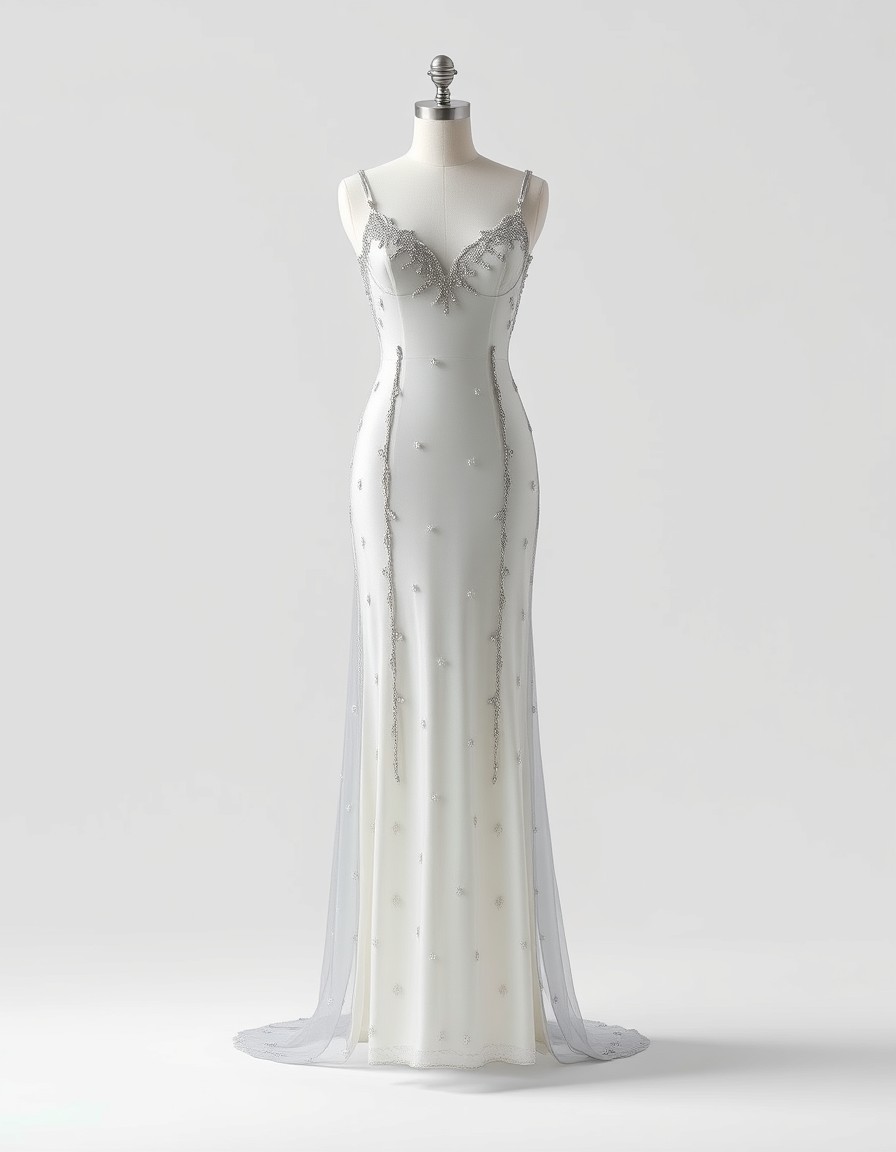
Open the dress library and choose a bridal look — for example the Silver Bridal shown above — or upload a gown photo you found online.
- 4
Generate and study the drape
In about twenty seconds the gown is on your body. Zoom in on the bodice seam, the waistline and how the skirt falls.
- 5
Try the rivals
Swap in the other silhouettes on your shortlist. Same face, same pose — a perfectly fair comparison.
- 6
Save the winner
Keep the results for the salon visit or for your tailor's alterations estimate.
Common mistakes to avoid
- Trying only white. Ivory, champagne and blush read completely differently against your skin — compare at least two tones.
- Judging from a cropped or seated photo; the AI has to guess your full proportions and hems land wrong.
- Forgetting the venue. A ballgown that stuns on screen will fight for space in a tiny registry office.
- Stopping at one winner. Salons report that most brides end up in a gown from their second or third choice — keep at least three in the running.
- Treating the render as exact lace and beadwork. AI try-on shows silhouette, drape and color faithfully; embroidery detail always deserves a real-life look before purchase.
Can I really try on wedding dresses at home for free?
Yes. Twirldress's first try-on is free once you sign in: upload a full-body photo, pick a bridal gown from the library (or upload one), and see it on you in about twenty seconds. Extra viewing angles use credits.
How realistic is an AI wedding dress try-on?
Silhouette, drape, color and how the gown follows your proportions are rendered realistically enough to build a confident shortlist. Fine detail like beading and lace texture is indicative — confirm that at the salon on the real gown.
Can I try on a specific dress I found online?
Yes. Alongside the built-in library you can upload any gown photo — a designer product shot, a screenshot from Pinterest — and the AI will dress you in it, keeping your face, pose and background.
How many dresses should I try before the salon?
Aim for six to ten: one or two from each silhouette, then variations of the winning family. That's the same count as a salon appointment, except it's free and each one is on your own body.
Will the salon take my AI try-on results seriously?
Consultants work from visual briefs all day — a photo of a silhouette on your actual body communicates faster than adjectives. Bring your saved gallery and ask them to pull the closest real gowns.
The bottom line
Knowing how to try on wedding dresses at home turns the search from a expensive guessing game into a funnel: test silhouettes freely on your own photo, shortlist with confidence, then spend your one salon visit on gowns that already have a proven track record on your body. Start free, compare honestly, and enjoy the part that used to be the stressful bit.
Ready to see it on you?
Upload a photo and slip into any dress from our library — sign in and your first try-on is free.